♟ ELO Rating Calculator
Calculate exact ELO rating changes for chess, competitive games & tournaments
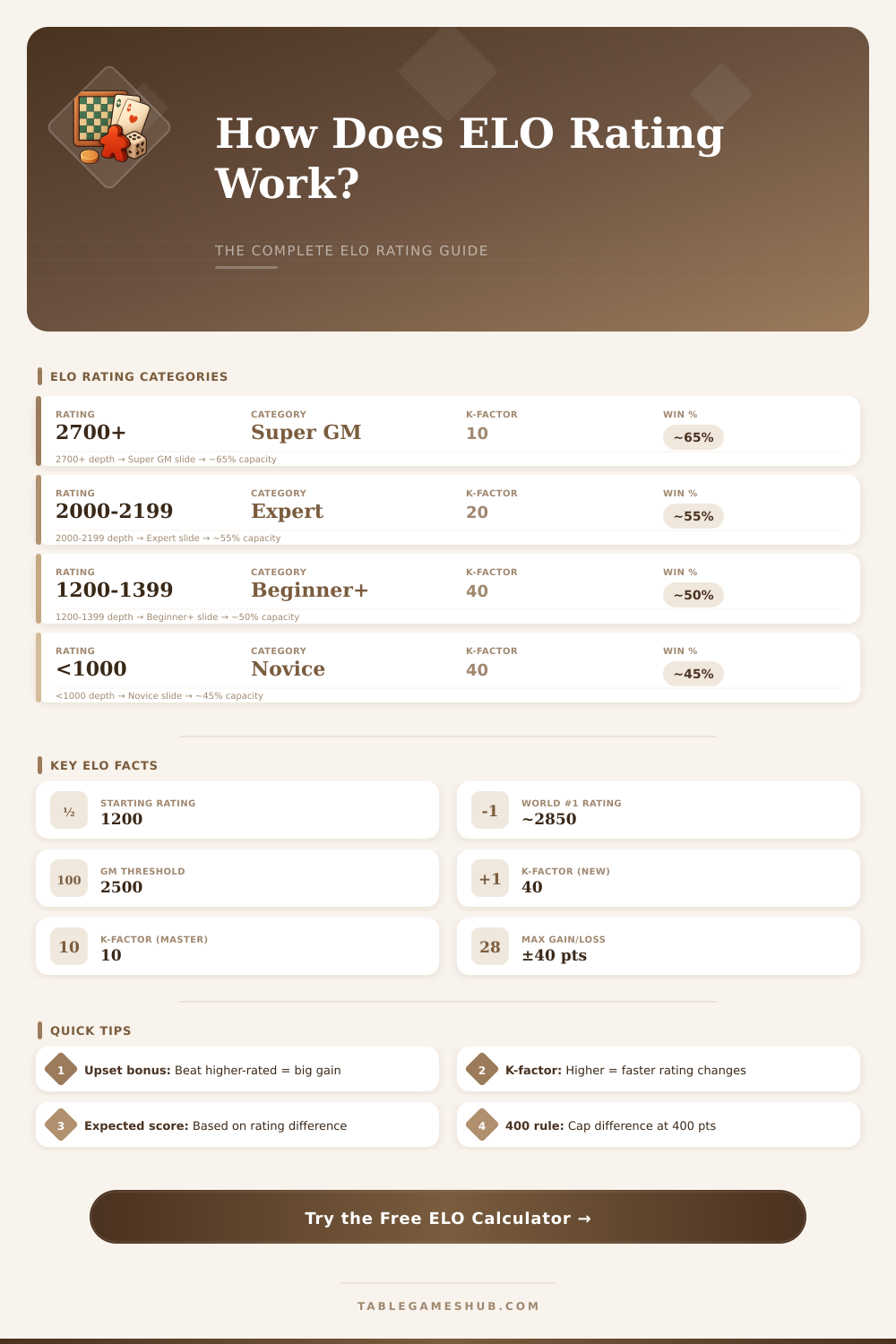
| Rating Range | Category | FIDE K-Factor | USCF K-Factor | Win % vs Equal | Notes |
|---|---|---|---|---|---|
| < 1000 | Absolute Beginner | 40 | 32 | 50% | Learning fundamentals |
| 1000 – 1199 | Novice | 40 | 32 | 50% | Knows basic tactics |
| 1200 – 1399 | Beginner Plus | 40 | 32 | 50% | Regular club player |
| 1400 – 1599 | Intermediate | 20 | 24 | 50% | Understands strategy |
| 1600 – 1799 | Advanced | 20 | 24 | 50% | Tournament player |
| 1800 – 1999 | Expert / Candidate Master | 20 | 16 | 50% | Strong tournament play |
| 2000 – 2199 | National Master | 10 | 16 | 50% | USCF National Master |
| 2200 – 2299 | FIDE Master | 10 | 16 | 50% | FIDE FM title |
| 2300 – 2399 | International Master | 10 | 16 | 50% | FIDE IM title |
| 2400 – 2499 | Near-Grandmaster | 10 | 16 | 50% | IM with norms |
| 2500 – 2699 | Grandmaster | 10 | 16 | 50% | FIDE GM title |
| 2700+ | Super Grandmaster | 10 | 16 | 50% | World elite |
| Rating Diff (Higher – Lower) | Expected Score (Higher) | Expected Score (Lower) | Win % (Higher) | Win % (Lower) |
|---|---|---|---|---|
| 0 (Equal) | 0.500 | 0.500 | 50.0% | 50.0% |
| 25 | 0.535 | 0.465 | 53.5% | 46.5% |
| 50 | 0.571 | 0.429 | 57.1% | 42.9% |
| 100 | 0.640 | 0.360 | 64.0% | 36.0% |
| 150 | 0.702 | 0.298 | 70.2% | 29.8% |
| 200 | 0.760 | 0.240 | 76.0% | 24.0% |
| 250 | 0.808 | 0.192 | 80.8% | 19.2% |
| 300 | 0.849 | 0.151 | 84.9% | 15.1% |
| 350 | 0.882 | 0.118 | 88.2% | 11.8% |
| 400+ | 0.909 | 0.091 | 90.9% | 9.1% |
| Game / System | Starting Rating | K-Factor | Rating Floor | Top Rating (approx) |
|---|---|---|---|---|
| Chess (FIDE) | 1000 | 10/20/40 | 1000 | ~2850 (Carlsen) |
| Chess (USCF) | Provisional | 16/24/32 | 100 | ~2900 |
| Chess (Lichess) | 1500 | Variable | No floor | ~3300 (online) |
| Chess (Chess.com) | 1200 | Variable | No floor | ~3300 (online) |
| Go (AGA) | 1200 | Variable | No floor | ~2700 |
| Scrabble (NASPA) | 500 | 32 | 200 | ~2200 |
| Table Tennis (ITTF) | 1000 | Variable | 1000 | ~3100 (Fan Zhendong) |
| Backgammon | 1500 | Variable | No floor | ~2000+ |
| Session (5 games vs equal) | K=10 Change | K=20 Change | K=40 Change | Result |
|---|---|---|---|---|
| 5 wins, 0 losses, 0 draws | +25 | +50 | +100 | Strong gain |
| 4 wins, 1 loss, 0 draws | +15 | +30 | +60 | Good gain |
| 3 wins, 1 loss, 1 draw | +10 | +20 | +40 | Moderate gain |
| 3 wins, 2 losses, 0 draws | +5 | +10 | +20 | Small gain |
| 2 wins, 2 losses, 1 draw | 0 | 0 | 0 | No change |
| 1 win, 3 losses, 1 draw | -5 | -10 | -20 | Small loss |
| 0 wins, 5 losses, 0 draws | -25 | -50 | -100 | Large loss |
In the 1950s, Hungarian-American physicist called Arpad Elo created a system that now applies everywhere, from chess to video games. One sometimes writes it with capital letters as ELO, but it is not an acronym, simply his surname. One says it “EE-loo”.
ELO Rating at its base is an easy way to guess the skill of players in direct games like chess. Every player gets a number that adjusts up or down based on the results of games. A bigger number shows that you are stronger.
How ELO Ratings Work
If you win you receive points from the loser.
The difference between the ratings of two players determines how many points will adjust after a match. And it also shows who will probably win. Two players of same level?
That is like a coin flip, so around 50 percent for each. If you play against someone that is rated 100 points under you, you would have about a 64 percent chanec to win such games, which matches to eight wins from ten games. Add another 100 points to your lead, and you reach around 75 percent of wins against that player.
Here is where it gets cool: when a strong favorite player wins, his rating almost does not move, because one expects that of him. But a surprising loss? Then both ratings adjust much more.
The system is based on figuring out wear every person really sits in the ranking of players.
In ELO Rating everything depends on the results, not on how many points you already have. The main difference between ratings of 1500 and 1800 lies in how often one wins and how big are those wins. Players with higher rating simply beat stronger competition.
Here is what makes the rating fair, without personal opinions of any.
There is one quirk about this you must know: two players can have the same record of wins and losses, but end with different ratings. That happens because your rating always depends on your current position. The system can also go wrong badly, especially if the same people play together without many new games entering.
Chess made ELO Rating famous globally. Magnus Carlsen, the current world champion, has the highest rating in classical chess among people. Computer programs however passed everyone, they reach around 3490 in chess, much more than any person can.
The international chess group uses factors of 10, 20 or 40 based on the age of the player, the type of game and the current rating.
Beyond chess, ELO Rating spread to other areas. The world football ELO Rating rankings sort national teams with a changed version that considers goal counts, event weights and home advantage. In Tabula Game Arena one uses ELO Rating for online games, with 60-point change for the first ten games, then 40 for the next ten, and finally 20 after that.
Those ratings start at zero and move afterevery ranked match.
What makes ELO Rating this good is that it works well in zero-sum games… Where the prize of one is the cost of the other. It is nice because of its simplicity, yet so strong that new competitive fields keep using it.