🪨 Mancala Calculator
Calculate seed distributions, move outcomes, store totals & optimal setups for any Mancala variant
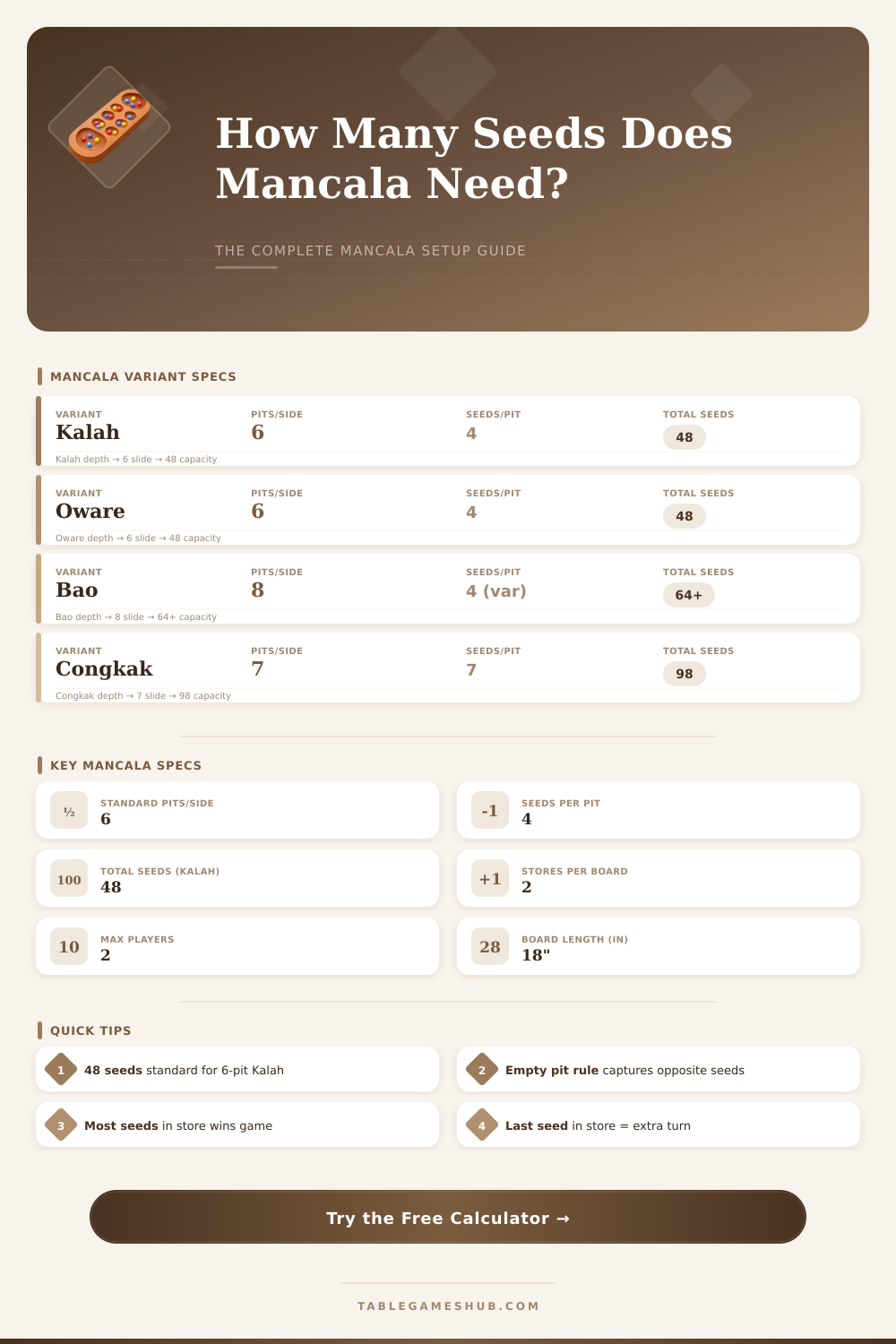
| Variant | Pits/Side | Seeds/Pit | Total Seeds | Stores | Players | Avg Game Time |
|---|---|---|---|---|---|---|
| Kalah | 6 | 4 | 48 | 2 | 2 | 10–20 min |
| Oware / Awari | 6 | 4 | 48 | 2 | 2 | 15–30 min |
| Congkak | 7 | 7 | 98 | 2 | 2 | 20–40 min |
| Bao | 8 | 4–6 | 64–96 | 2 | 2 | 30–60 min |
| Wari | 6 | 4 | 48 | 2 | 2 | 15–25 min |
| Extended Kalah | 8 | 4 | 64 | 2 | 2 | 20–35 min |
| Board Type | Length | Width | Pit Diameter | Playing Area |
|---|---|---|---|---|
| Standard 6-pit | 18 in / 46 cm | 6 in / 15 cm | 2 in / 5 cm | 108 in² |
| Travel / Plastic | 12 in / 30 cm | 4 in / 10 cm | 1.5 in / 4 cm | 48 in² |
| Deluxe Wood 6-pit | 22 in / 56 cm | 8 in / 20 cm | 2.5 in / 6 cm | 176 in² |
| Extended 8-pit | 24 in / 61 cm | 7 in / 18 cm | 2 in / 5 cm | 168 in² |
| Congkak 7-pit | 20 in / 51 cm | 6 in / 15 cm | 2 in / 5 cm | 120 in² |
| Component Set | Seed Count | Seed Type | Avg Seed Size | Best For |
|---|---|---|---|---|
| Wooden Board (Standard) | 48 | Polished stone | 0.6 in / 15 mm | Kalah, Oware |
| Marble Set | 48 | Glass marble | 0.5 in / 13 mm | Kalah, Wari |
| River Stone Set | 48 | Flat river stone | 0.7 in / 18 mm | Oware |
| Glass Bead Set | 72 | Glass bead | 0.4 in / 10 mm | Congkak, Bao |
| Plastic Travel Board | 48 | Plastic pellet | 0.5 in / 13 mm | Travel, Kids |
| Deluxe Wood Board | 96 | Mixed gems | 0.6 in / 15 mm | Extended variants |
| Tournament Set | 60 | Uniform stone | 0.6 in / 15 mm | Tournament |
| Kids Set | 36 | Plastic pebble | 0.8 in / 20 mm | Kids, 3-seed |
| Pits/Side | Seeds/Pit | Total Seeds | Seeds/Player | Win Threshold | Moves to Empty |
|---|---|---|---|---|---|
| 6 | 3 | 36 | 18 | 19 | ~18 |
| 6 | 4 | 48 | 24 | 25 | ~24 |
| 6 | 6 | 72 | 36 | 37 | ~36 |
| 7 | 7 | 98 | 49 | 50 | ~42 |
| 8 | 4 | 64 | 32 | 33 | ~32 |
| 8 | 5 | 80 | 40 | 41 | ~38 |
Simple game of Mancala, that puts two players one against the other in a fight between numbers and skill of thought. The main idea? Beat your opponent by means of smart movement of the stones around the board and their capture in your scoring zone.
One grabs the bits and lays them one after the other while one turns, and the one that collects the most points wins. It seems quite easy even so it requires strong skill count and a bit of real planning strategy.

How to Play Mancala and Use a Move Calculator
Here is where the calculator for Mancala comes in. Those programs help you figure out what moves will give you the most profit during the game. Some of them focus especially on the variant Mancala Avalanche, that is very popular.
One puts in the present number of stones in every line, and it gives the series of actions, that will boost your prize. There is even a solver done specially for the Avalanche-version of GamePigeon in iMessage, and one especially clever one using the Cloud Vision of Google-API to scan the board in iMessage and later advise the best move.
Here is how the real game flows: one takes all stones from one line and lays them one by one around the board in a circle. The last stone, that one lays? It has big weight.
If it falls in your score, you get a point plus an extra turn. If it ends in an empty line on your side, the stones of the opponent in the opposite line get captured. Both go in your scoring pit.
The match ends, when some one reaches 25 points or more. The cup on your write side is simply your main treasure spot.
Start by means of the third line is a tactic, that I commonly saw work, when one goes first. The last stone usually ends exactly in your scoring zone, what gives you a point and an immediate extra turn. After mastering the basic rules, the real challenge becomes to count, and seize the bits of your opponent before they can reach yours.
Mancala is designed for children of three years up, and a typical game lasts around ten minutes. The skills used during the game, calculation, simple math, tactical and strategic thought, help both children and adults. There is a whole world of variants of Mancala.
More than a hundred different versions exist, and many modern ones adapt weekly games. The name comes from the way the bits spread across the board, usually one by one. One can even find setups for four players, that work similar to the traditional double game, but with space for double the number of opponents.
Various cultures have their ownadaptations of the rules and board forms of Mancala.
What makes Mancala interesting from a math viewpoint, is its neat simplicity. In most cases, a player has only six possible moves in any turn. This limit is especially what makes the creation of a calculator or algorithm for it such an attractive task.