🏆 Swiss Tournament Calculator
Calculate rounds, standings, pairings, tiebreakers & top-cut for any Swiss-format event
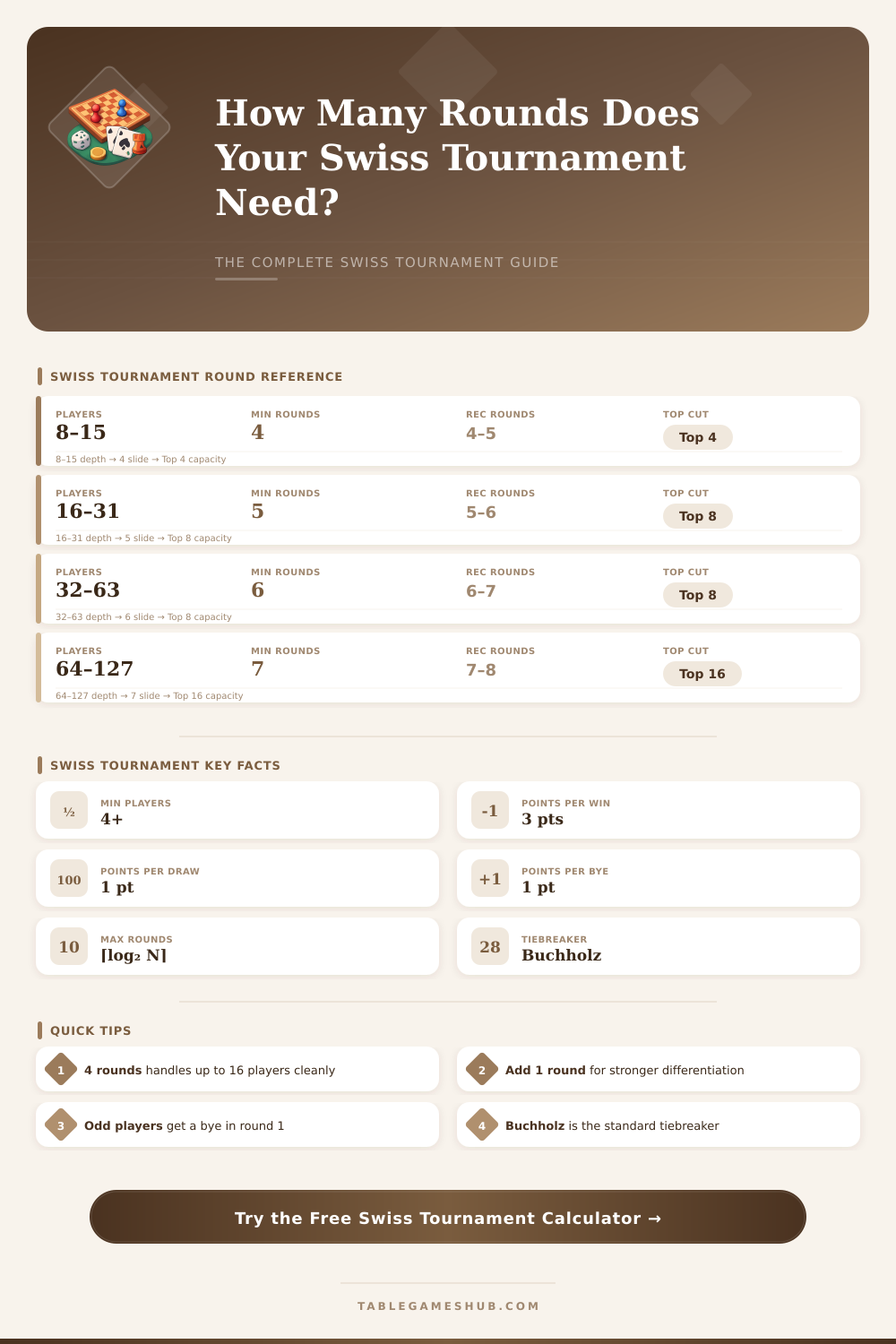
| Players | Min Rounds (log₂N) | Recommended Rounds | Top Cut | Est. Duration (50 min/rd) |
|---|---|---|---|---|
| 4–7 | 3 | 3–4 | Top 4 | 3–4 hrs |
| 8–15 | 4 | 4–5 | Top 4 | 4–5 hrs |
| 16–31 | 5 | 5–6 | Top 8 | 5–6 hrs |
| 32–63 | 6 | 6–7 | Top 8 | 6–7 hrs |
| 64–127 | 7 | 7–8 | Top 16 | 7–9 hrs |
| 128–255 | 8 | 8–9 | Top 16–32 | 9–11 hrs |
| 256+ | 9 | 9–10 | Top 32–64 | 10–13 hrs |
| Game | Win Points | Draw Points | Loss Points | Primary Tiebreaker |
|---|---|---|---|---|
| Chess (FIDE) | 1.0 | 0.5 | 0 | Buchholz / SB |
| Chess (Match pts) | 3 | 1 | 0 | Buchholz |
| MTG / Pokemon TCG | 3 | 0 | 0 | Opp. Match-Win % |
| Scrabble | 1 | 0 | 0 | Point Spread |
| Board Games | 3 | 1 | 0 | SOS |
| Go / Baduk | 1 | — | 0 | SOS |
| Shogi | 1 | — | 0 | SOS / Buchholz |
| Rounds | Max (Win=3, Draw=1) | Max (Win=3, Draw=0) | Max (Win=1, Draw=0) | FIDE (Win=1, Draw=0.5) |
|---|---|---|---|---|
| 3 | 9 | 9 | 3 | 3.0 |
| 4 | 12 | 12 | 4 | 4.0 |
| 5 | 15 | 15 | 5 | 5.0 |
| 6 | 18 | 18 | 6 | 6.0 |
| 7 | 21 | 21 | 7 | 7.0 |
| 8 | 24 | 24 | 8 | 8.0 |
| 9 | 27 | 27 | 9 | 9.0 |
Swiss tournament erases entirely the knockout part, the players keep participating in rounds one after another independently of how many defeats they have. It differs from the knockout systems especially because of that. Instead of being dumped after one single defeat, all stay in the game.
The system for pairing works by matching the participants according to their total points after every round, so that winners struggle against other winners and losers with alike losers. Like this the whole thing stays fair during the whole event.
How Swiss Tournaments Work
This format first appeared in a chess tournament in Zurich in 1895. The chess players created this system and the intention was simple: find a way to manage big groups of players without each having to play against each other.
Here is the main improvement. In round-robin tournaments, every player must face each other player. With four participants it is easy, only three rounds.
But if one adds it to 32 players, then one requires 31 rounds. That becomes a planning nightmare ready to burst. Tournaments in Swiss style settle tihs problem.
Here is how it genuinely works in practice. Usually one starts with casual pairings to mix everything. Later the players sort according to their present result and one matches them with those that have alike number of victories and defeats.
Every round gives points according to what happened. Because the winners always struggle against other winners, the group naturally shrinks as more rounds pass and fewer players stay equally at the peek.
One good advantage? The duration of the tournament is planned all along. The players know exactly how many games they will have before starting.
Organizers commonly use the square root of the total number of participants to set the rounds, but there is a lot of flexibility. One decides the number of rounds weighing the chance to genuinely have a clear champion against the practical limits, time, money, place, such things.
That format can work also for very big events. Thousands of players? No trouble.
Each has a chance to compete, and the final standings show the real results. To organize such tournaments does not require huge budgets or big teams, and so they became soliked in various gaming groups.
Swiss tournaments moved out from the chess world a long time ago. Magic the Gathering uses them, likewise board games like Warhammer and Kings of War. Even online gaming platforms adopted the Swiss form.
What makes it work is that no two players ever meet the same enemies twice, and the rounds last until all planned matches end or until the decided number of rounds. When players end with same results, one uses tie-breakers to separate them, things like total points got during the whole event help to decide the ranks.