🃏 Bridge Card Combination Calculator
Calculate hand combinations, suit distributions, and probabilities for contract bridge
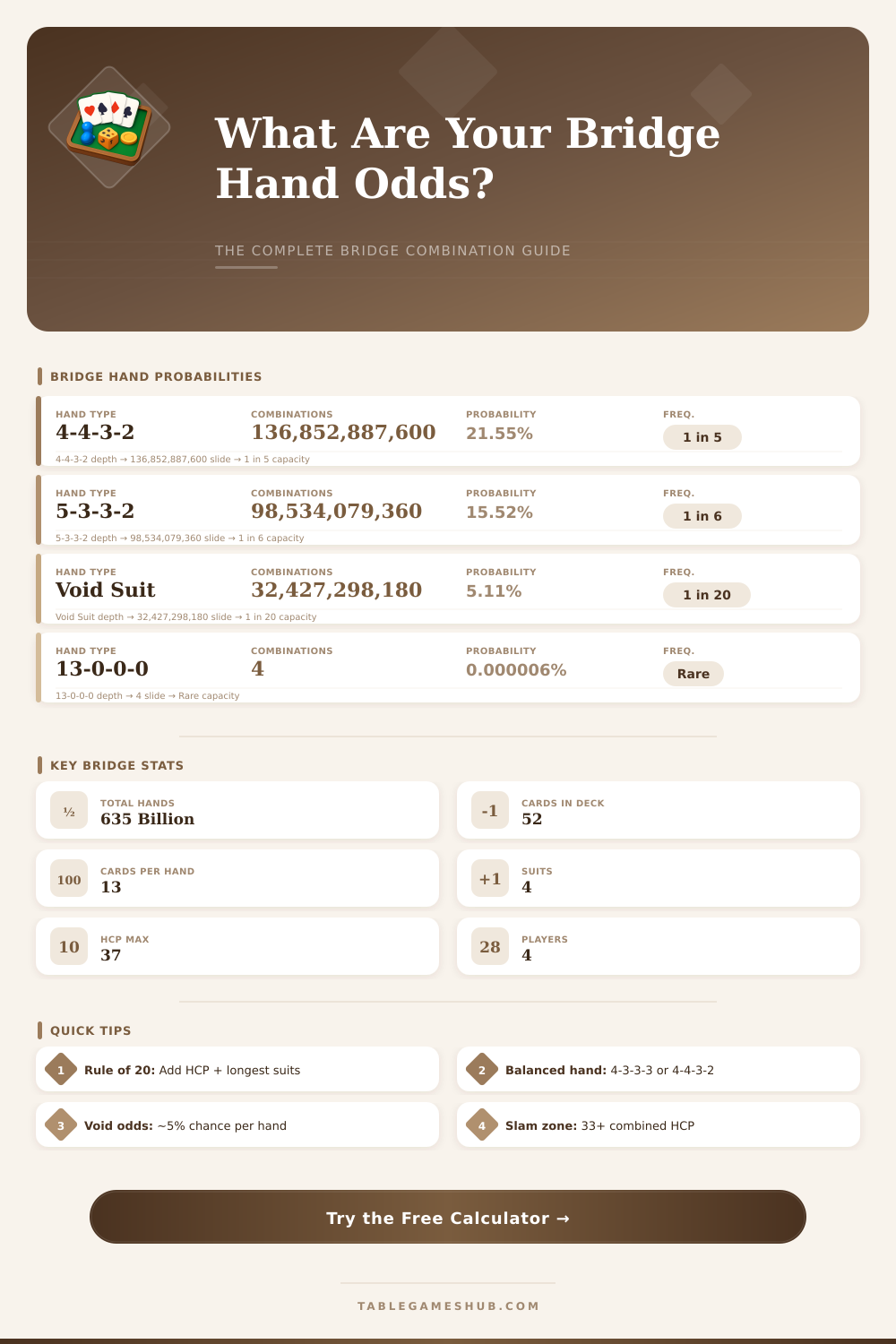
| Distribution (suits) | Combinations | Probability | Frequency | Hand Type |
|---|---|---|---|---|
| 4-4-3-2 | 136,852,887,600 | 21.55% | 1 in 5 | Balanced |
| 5-3-3-2 | 98,534,079,360 | 15.52% | 1 in 6 | Semi-balanced |
| 5-4-3-1 | 84,403,452,000 | 12.93% | 1 in 8 | Unbalanced |
| 4-3-3-3 | 66,905,856,160 | 10.54% | 1 in 9 | Balanced |
| 6-3-2-2 | 56,756,961,600 | 5.64% | 1 in 18 | Unbalanced |
| 6-4-2-1 | 48,438,925,920 | 4.70% | 1 in 21 | Unbalanced |
| 5-4-4-0 | 4,082,498,880 | 1.24% | 1 in 81 | Void |
| 7-3-2-1 | 20,160,786,240 | 3.88% | 1 in 26 | Long suit |
| 6-5-1-1 | 3,421,322,400 | 0.70% | 1 in 143 | Two-suiter |
| 8-2-2-1 | 3,090,736,080 | 0.47% | 1 in 213 | Long suit |
| HCP Range | Probability | Bid Meaning | Avg Tricks |
|---|---|---|---|
| 0-5 | ~19% | Weak / Pass | 0-2 |
| 6-9 | ~28% | Weak / Responding | 2-4 |
| 10-11 | ~15% | Invitational | 4-5 |
| 12-14 | ~22% | Minimum Opening | 5-7 |
| 15-17 | ~12% | 1NT Opening | 7-8 |
| 18-19 | ~3% | Strong Opening | 8-9 |
| 20-21 | ~0.9% | 2NT Opening | 9-10 |
| 22+ | ~0.2% | 2♣ Opening | 10-13 |
| Missing Cards | Best Split | Probability | Recommended Play |
|---|---|---|---|
| 2 missing | 1-1 | 52.0% | Play for split |
| 3 missing | 2-1 | 78.0% | Play for split |
| 4 missing | 2-2 | 40.7% | 3-1 more likely (49.7%) |
| 5 missing | 3-2 | 67.8% | Play for 3-2 |
| 6 missing | 3-3 | 35.5% | 4-2 more likely (48.4%) |
| 7 missing | 4-3 | 62.2% | Play for 4-3 |
| Variant | Players | Deals per Session | Avg Duration |
|---|---|---|---|
| Contract Bridge | 4 | 20-30 | 3-4 hours |
| Rubber Bridge | 4 | Varies | 2-3 hours |
| Duplicate Bridge | 4 (pairs) | 24-27 | 3.5-4 hours |
| Chicago Bridge | 4 | 4 (fixed) | 45-60 min |
| Honeymoon Bridge | 2 | 10-15 | 1-1.5 hours |
Play of Card combinations simply comes down to one main spot: count the most brilliant way use the cards, that you and your partner has, for win the most of tricks. In any given colour you can control both hands and later choose the strategy, that best improves your chances. Here enter the finesses and other tactics in the cause.
This does the Bridge game entirely different than many other Card games. While you play, the hand of your partner lies directly before you so you can observe the whole situation and plan ahead. Decide, whether play from your own hand or reach across and use the cards of your partner, becomes key part of the strategy.
Count the Cards and Choose the Best Play
Probably exists a math model for that, as the cards of the opponents can split. If they have three cards between them, those can divide in almost eight diffreent ways. Four cards?
They play to sixteen possible setups. The model simply doubles the numbers, during the count grow.
Assume, that your partnership owns AQ9x in one hand and Jxxx in the second, very common case. The write actions depend entirely on how many cards the opponent before you has in that colour. If he keeps only two, you play low Card to the Queen, later cash the Ace.
So if he has three cards here, lead by means of the Jack first commonly result in better game.
Other situation is A9xx against KJxx, where you must not lose more than one trick, while you take at least three. The winning way? Cash the King first, later go to the A9 for your finesse or lead to the Jack vice versa.
That order handle every possible arrangement, that the opponents can have.
When deal about seven or more cards in colour, the usual method is bid to fall the Jack. The cause is, that the order, in that you pull the Ace, King and Queen, genuinely affect the result. And here important spot: the Card combinations never work alone.
The whole structure of the hand decides, what you do.
Great are useful to study those particular designs of cards, so that players feel themselves comfortable in such moments. Every Card shows combination on the face, and overturn it strip the right play line left. They address both shots of the table, declarer games and back games likewise.
Alan Truscott, British-American Bridge expert, that wrote thirteen books and led the Bridge column of the New York Times during more than four decades, created those tools.
For declarers, that wants to improve themselves, combine the chances. Search Card combinations, that beat fifty percent chances, is good strategy. Know, when lead high Card instead of lead to it, are genuinely key.
The target is simple: find the way, that gives the mostchance for take the tricks, that you genuinely need.