🀄 Riichi Mahjong Score Calculator
Calculate han, fu, and point totals for any riichi mahjong hand — including dealer/non-dealer payments and limit hands
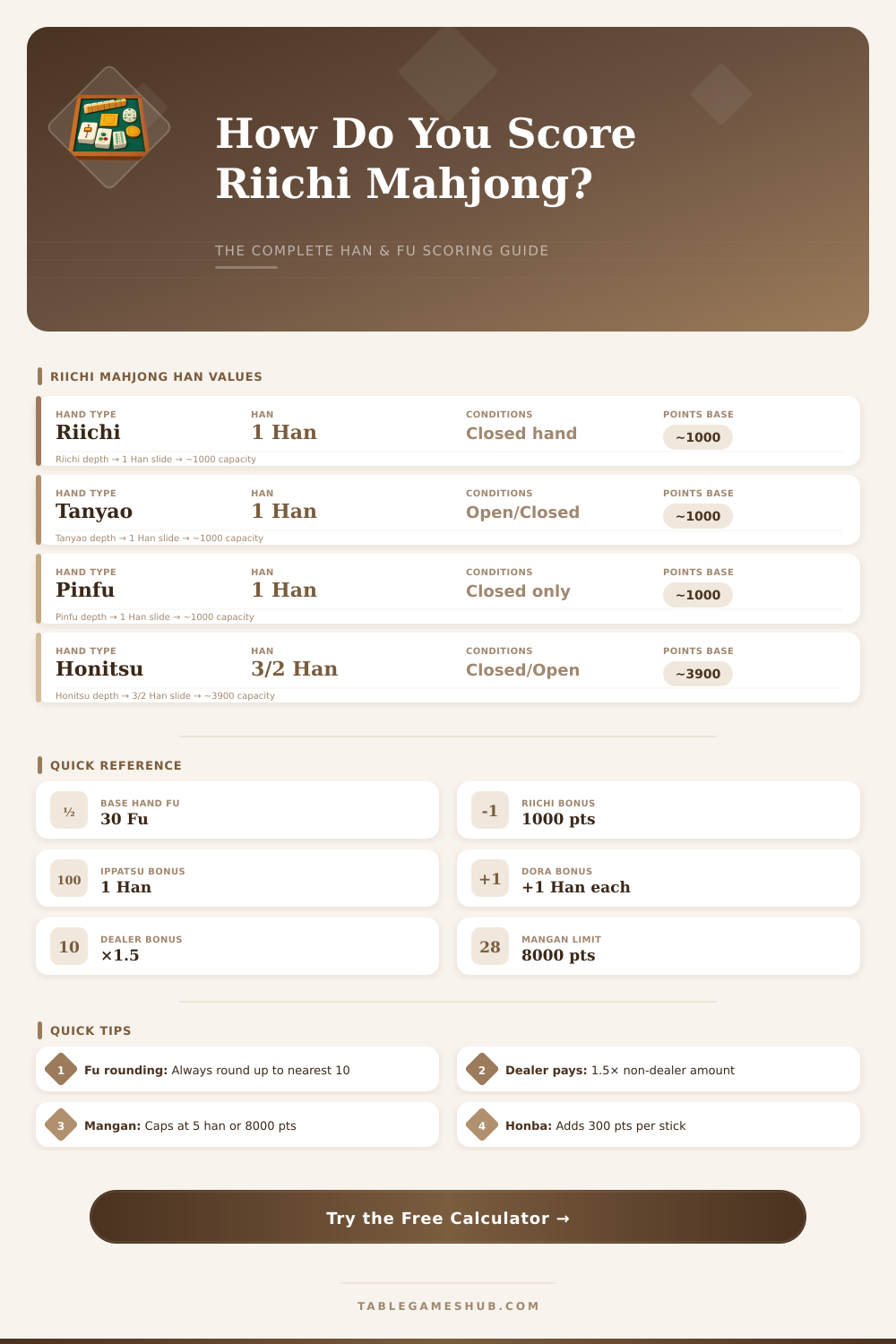
| Yaku (Hand Type) | Han (Closed) | Han (Open) | Notes |
|---|---|---|---|
| Riichi | 1 | N/A | Closed only; bet 1000 pts |
| Double Riichi | 2 | N/A | Riichi on first discard |
| Ippatsu | 1 | N/A | Win within one go-around after riichi |
| Menzen Tsumo | 1 | N/A | Self-draw, closed hand |
| Tanyao | 1 | 1 | All simples (2-8 tiles only) |
| Pinfu | 1 | N/A | All sequences, two-sided wait |
| Iipeiko | 1 | N/A | Two identical sequences, closed |
| Yakuhai (Hatsu) | 1 | 1 | Triplet of green dragon |
| Yakuhai (Haku) | 1 | 1 | Triplet of white dragon |
| Yakuhai (Chun) | 1 | 1 | Triplet of red dragon |
| Seat/Round Wind | 1 | 1 | Triplet of seat or round wind |
| Chanta | 2 | 1 | Terminal or honor in each set |
| Sanshoku Doujun | 2 | 1 | Same sequence in all 3 suits |
| Ittsu (Pure Straight) | 2 | 1 | 1-2-3, 4-5-6, 7-8-9 same suit |
| Toitoi | 2 | 2 | All triplets |
| Sanankou | 2 | 2 | Three concealed triplets |
| Honitsu | 3 | 2 | One suit + honors |
| Chiitoi | 2 | N/A | Seven pairs (25 fu fixed) |
| Junchan | 3 | 2 | Terminal in every set |
| Ryanpeiko | 3 | N/A | Two sets of identical sequences |
| Chinitsu | 6 | 5 | All one suit, no honors |
| Kokushi Musou | Yakuman | N/A | 13 orphans + duplicate |
| Suuankou | Yakuman | N/A | Four concealed triplets |
| Daisangen | Yakuman | Yakuman | All three dragon sets |
| Tsuuiisou | Yakuman | Yakuman | All honors hand |
| Ryuuiisou | Yakuman | Yakuman | All green tiles |
| Situation | Fu Added | Example | Notes |
|---|---|---|---|
| Base fu (closed ron) | +30 | Standard closed ron | Always applied |
| Base fu (tsumo / open) | +20 | Open or tsumo win | Pinfu tsumo = 20 |
| Tsumo win | +2 | Self-draw tile | Applied per tile drawn |
| Closed sequence (chi) | +0 | Any closed sequence | Sequences = 0 fu |
| Open sequence (chi) | +0 | Open chi call | Sequences = 0 fu |
| Simples triplet (closed) | +4 | Closed 333 simples | 2-8 tiles |
| Simples triplet (open) | +2 | Open pon simples | 2-8 tiles |
| Terminals/honors triplet (closed) | +8 | Closed 111 terminals | 1, 9 or honors |
| Terminals/honors triplet (open) | +4 | Open pon terminals | 1, 9 or honors |
| Simples quad (closed) | +16 | Closed kan simples | Kan = 4x triplet fu |
| Terminals/honors quad (closed) | +32 | Closed kan terminals | Highest fu set |
| Pair of value tiles | +2 | Pair of dragons/winds | Dragons, seat/round wind |
| Two-sided wait | +0 | 45 waiting for 3 or 6 | Best wait = 0 fu |
| Closed single-sided wait | +2 | Tanki/kanchan/penchan | Harder waits |
| Limit Hand | Han Threshold | Dealer (Ron/All) | Non-Dealer (Ron) |
|---|---|---|---|
| Mangan | 5 han (or 4 han 30+ fu) | 8,000 | 8,000 |
| Haneman | 6-7 han | 12,000 | 12,000 |
| Baiman | 8-10 han | 16,000 | 16,000 |
| Sanbaiman | 11-12 han | 24,000 | 24,000 |
| Yakuman | 13+ han | 32,000 | 32,000 |
| Double Yakuman | Special yaku | 64,000 | 64,000 |
| Limit / Points | Non-Dealer Wins (each pays) | Dealer Wins (each pays) | Total Received |
|---|---|---|---|
| Mangan (Non-Dealer) | Dealer: 4,000 / Others: 2,000 | All: 2,000 | 8,000 |
| Mangan (Dealer) | — | All: 2,000 each | 8,000 total |
| Haneman (Non-Dealer) | Dealer: 6,000 / Others: 3,000 | — | 12,000 |
| Haneman (Dealer) | — | All: 4,000 each | 12,000 total |
| Baiman (Non-Dealer) | Dealer: 8,000 / Others: 4,000 | — | 16,000 |
| Yakuman (Non-Dealer) | Dealer: 16,000 / Others: 8,000 | — | 32,000 |
Riichi Mahjong is simply the Japanese version of the old Chinese game. Because four players seat around the table with tiles in the hand, the main goal is to complete his hand more quickly than the opponents for more points. It obeys the basic rules of other mahjong styles, even so it has its own character (special elements), that really strengthen the fun.
Statement of riichi is what separates this game. If your hand stays closed (that means, that you did not take any tiles from the other players) and you require only one piece to win, then you deserve to declare riichi. One calls that situation tenpai.
Basics of Riichi Mahjong
Declaring it is like all-in in poker; you take a brave step, that promises big prize, but face also real danger.
To declare riichi, you must do three things: one says it loudly, turn the last dumped tile face down on the table and lay 1000 points as stick beside the discard pile. Those 1000 go to the one that ultimately wins the hand. When the hand ends without a winner, the sticks simply stay there, waiting for the next success.
But here is the catch. If an opponent took your dumped tile for his victory, your riichi statement disappears, and you lose his 1000 points.
Riichi ranks among the most common yaku, that you will meet during the game. Yaku are base patterns for victory or special states, taht allow you to declare triumph. Not all yaku require unique tile combinations; some depend only on the circumstances, like riichi itself.
When you declare riichi, you already set one yaku, and if you successfully end the hand, you can gain even more points.
So, there is the rule of furiten, that commonly confuses newcomers. When you dump tiles, and one of them later becomes your winning tile, you can not use it. The only weigh to win by means of that tile is to draw it directly from the wall for the rest of the round.
The game adds also dora tiles into the mix, which simply shows that luck plays a bigger part. This surprise is almost what makes Riichi Mahjong so fun and stops matches from feeling boring. It became the most favourite version in Europe, and everything that the European Mahjong Association officially plays.
Newcomers commonly feel that the whole set of rules and tactics seems too heavy at first sight. It is smarter to learn the basics before going more deeply. Getting used to table wind, dora, han and simple yaku like tanyao, pinfu and toitoi can happen after which the main tile steps no longer feel strange.
The good thing about this game is how it sometimes rewards wild choices and rewards good habits in other moments. Even top level pros last bad periods, while total beginners sometimes getlucky.
The World Riichi Championship started in 2014, giving competitive players from the whole world, both pros and amateurs. A scene to test their skills together. Want to play online?
Programs like Mahjong Soul, Riichi City and Tabletop Game Arena let you enter matches directly from your browser with opponents from various lands. Tabletop Simulator gives another option, if you search for a more real table feeling without leaving your house.