🎳 Bowling RPM Calculator
Calculate your bowling ball revolution rate (RPM), bowler style classification, and ball motion profile
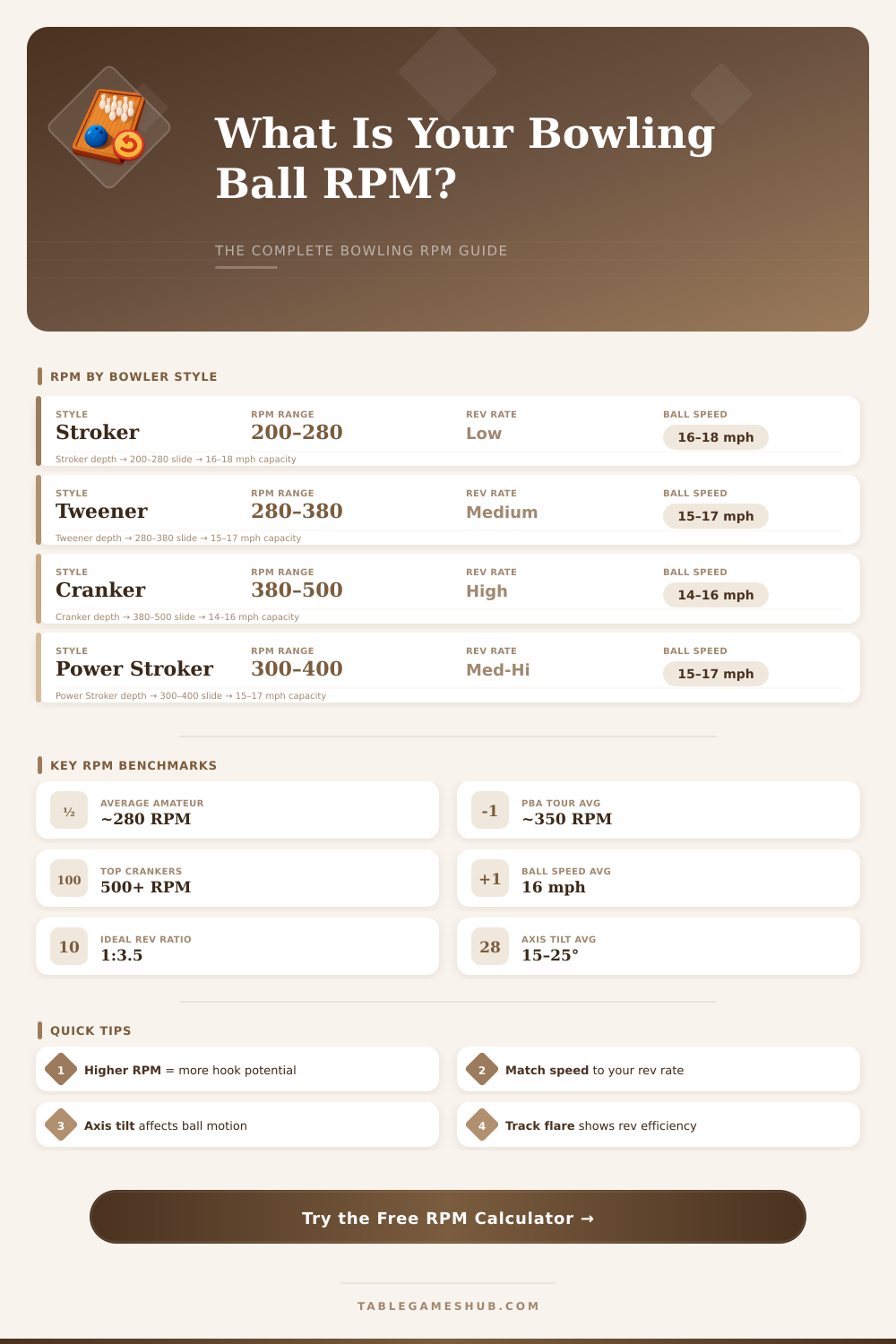
| Bowler Style | RPM Range | Avg Ball Speed | Axis Tilt | Axis Rotation | Hook Potential |
|---|---|---|---|---|---|
| Beginner / Straight | 100–200 | 12–14 mph | 0–10° | 0–15° | Very Low |
| Stroker | 200–280 | 16–18 mph | 10–20° | 30–60° | Low–Medium |
| Tweener | 280–380 | 15–17 mph | 15–25° | 45–75° | Medium |
| Power Stroker | 300–420 | 15–17 mph | 15–30° | 45–75° | Medium–High |
| Cranker | 380–500 | 14–16 mph | 20–35° | 60–90° | High |
| Two-Handed | 400–600 | 14–16 mph | 5–15° | 60–90° | Very High |
| Backup Ball | 150–300 | 13–16 mph | 10–25° | 30–60° | Reverse Hook |
| Spinner | 200–350 | 14–17 mph | 60–90° | 80–90° | Low (late) |
| Ball Speed (mph) | Ideal RPM | Low RPM (min) | High RPM (max) | Lane Condition |
|---|---|---|---|---|
| 12 mph | 200 | 150 | 260 | Dry preferred |
| 14 mph | 235 | 180 | 300 | Dry–Medium |
| 15 mph | 250 | 190 | 325 | Medium |
| 16 mph | 267 | 200 | 350 | Medium |
| 17 mph | 284 | 215 | 370 | Medium–Heavy |
| 18 mph | 300 | 230 | 390 | Heavy preferred |
| 20 mph | 333 | 250 | 430 | Heavy oil |
| Axis Tilt | Axis Rotation | Ball Motion Type | Track Flare | Bowler Category |
|---|---|---|---|---|
| 0–10° | 0–20° | Rolly / Strong backend | High flare | Power Stroker |
| 10–20° | 30–60° | Arc motion | Medium flare | Stroker / Tweener |
| 15–25° | 45–75° | Skid-Snap | Medium flare | Tweener |
| 20–35° | 60–90° | Skid-Flip | High flare | Cranker |
| 5–15° | 60–90° | Strong hook, early | Very high | Two-Handed |
| 60–90° | 80–90° | Minimal hook (spinner) | Very low | Spinner |
When people mention RPM, they mean revolutions each minute, so the amount of whole revolutions that the Bowling ball does in a minute around its central axis. The ball clearly does not stay on the lane during a whole minute, so the number is calculated from the real spinning speed during its move down the lane.
Before RPM became the usual measure for all, players simply counted the visual rotations while the ball rolled from their hands until the pins. Like this one received a precise amount of revolutions on the lane itself. The current system of RPM unites everything, which makes it easier to compare the rotations that different players put on the ball.
What RPM Means in Bowling and How to Measure It
To count RPM, you need two pieces of info: the time that the ball passes in the air from the throw until when it touches the head pin, and the number of revolutions in that time. Simple video can help you reach RPM without needing fancy gear. In the end you receive an average RPM value, although it can change because of factors outside of your control.
The USBC offers a method where one counts ten throws and measures teh rotation of the ball according to “hours” on a clock face… Twelve hours match one whole revolution. There is also the rev counting mode, where you mark how many throws last one full rotation.
Today’s tablets take the heavy work on themselves with built-in calculators for speed and RPM.
Most balanced players aim for around 17 miles each hour with between 300 and 350 RPM. Players that stress speed, on the other hand, cast more quickly than 17 mph, but under 300 RPM, which gives fewer power to the ball. Those 300 to 350 RPM is the main range for competitive players.
Getting to 300 RPM really is not a big challenge for many folks, even for those with a bit less strict style. Amateur players can reach from 290 to 350 RPM at about 15 mph.
Two-handed players are a whole other story, they commonly reach clearly higher numbers of revs. Even less careful two-handed style commonly gives from 400 to 450 RPM. A one-handed player that uses a thumb hole grip in the ball and reaches such numbers?
They beat the average, but at professional tournaments that does knot surprise. Some professionals push the limits further. Robert Smith became famous for measuring above 600 RPM, and once even above 700 RPM in a throw.
Getting to such high RPM values in adult age really is hard. Most players with high rotation built it during youth and carried it as a natural advantage. The tilt of the axis also plays a role, low tilt does not give so many revolutions compared to high tilt during motion down the lane.
Even so accuracy stays the main element, together with making sure that the ball is in the right position before impact so that it still has speed during the hit. Switching to a lighter ball also can help boost the numbers. One player I know was stuck in the low to middle 300s witha 14-pound ball, but jumped to the high 300s or low 400s after he switched to a 12-pound ball.