🃏 Gin Rummy Points Calculator
Calculate deadwood, bonuses, undercut penalties & running totals for every hand
🏆 Player 1 (Knocker / Winner)
🤷 Player 2 (Defender)
| Scoring Event | Points Awarded | Who Receives | Conditions |
|---|---|---|---|
| Gin | Gin Bonus + opponent deadwood | Knocker | Knocker has 0 unmatched deadwood |
| Big Gin | Big Gin Bonus + opponent deadwood | Knocker | All 11 cards form valid melds |
| Knock (knocker wins) | Deadwood difference (opponent minus knocker) | Knocker | Knocker deadwood < opponent deadwood |
| Undercut | Undercut Bonus + deadwood difference | Defender | Defender deadwood <= knocker deadwood |
| Tie (equal deadwood) | Undercut Bonus (defender wins tie) | Defender | Both have identical deadwood totals |
| Line Bonus (Box Bonus) | +25 pts per hand won | Hand winner | Added at game end settlement |
| Game Bonus | +100 pts | Game winner | First to reach winning target |
| Shutout Bonus | Game bonus doubled | Game winner | Opponent never scored a point |
| Card | Point Value | Count in Deck | Notes |
|---|---|---|---|
| Ace (A) | 1 point | 4 (one per suit) | Lowest value; only goes A-2-3 in runs |
| 2 through 9 | Face value (2–9 pts) | 8 each rank | Pip cards count as printed number |
| 10 | 10 points | 4 | High deadwood card |
| Jack (J) | 10 points | 4 | Face card; high deadwood risk |
| Queen (Q) | 10 points | 4 | Face card; high deadwood risk |
| King (K) | 10 points | 4 | Highest rank; only K-Q-J in run |
| Max Possible Deadwood | ~98 points | — | All high cards unmatched (10-hand) |
| Knock Threshold | 10 points or fewer | — | Standard rule; Oklahoma uses upcard value |
| Variant | Knock Limit | Gin Bonus | Special Rules |
|---|---|---|---|
| Standard Gin Rummy | 10 pts | 25 pts | First to 100 pts wins |
| Oklahoma Gin | Value of upcard (1–10) | 25 pts | Spades dealt: all points doubled |
| Hollywood Gin | 10 pts | 25 pts | Scores applied to 3 simultaneous games |
| Straight Gin | 0 (gin only) | No bonus | No knocking allowed; must gin to win |
| Single Match Gin | 10 pts | 25 pts | One hand per game; no running total |
| Partnership Gin | 10 pts | 25 pts | Team totals combined for scoring |
Gin Rummy is a card game for two players, where the main task is to combine them in equal groups called sets. They can be made up of runs or from three and more alike cards. The first that reaches 100 Points beats, although commonly play until 250 Points depending on the level of competition in the party.
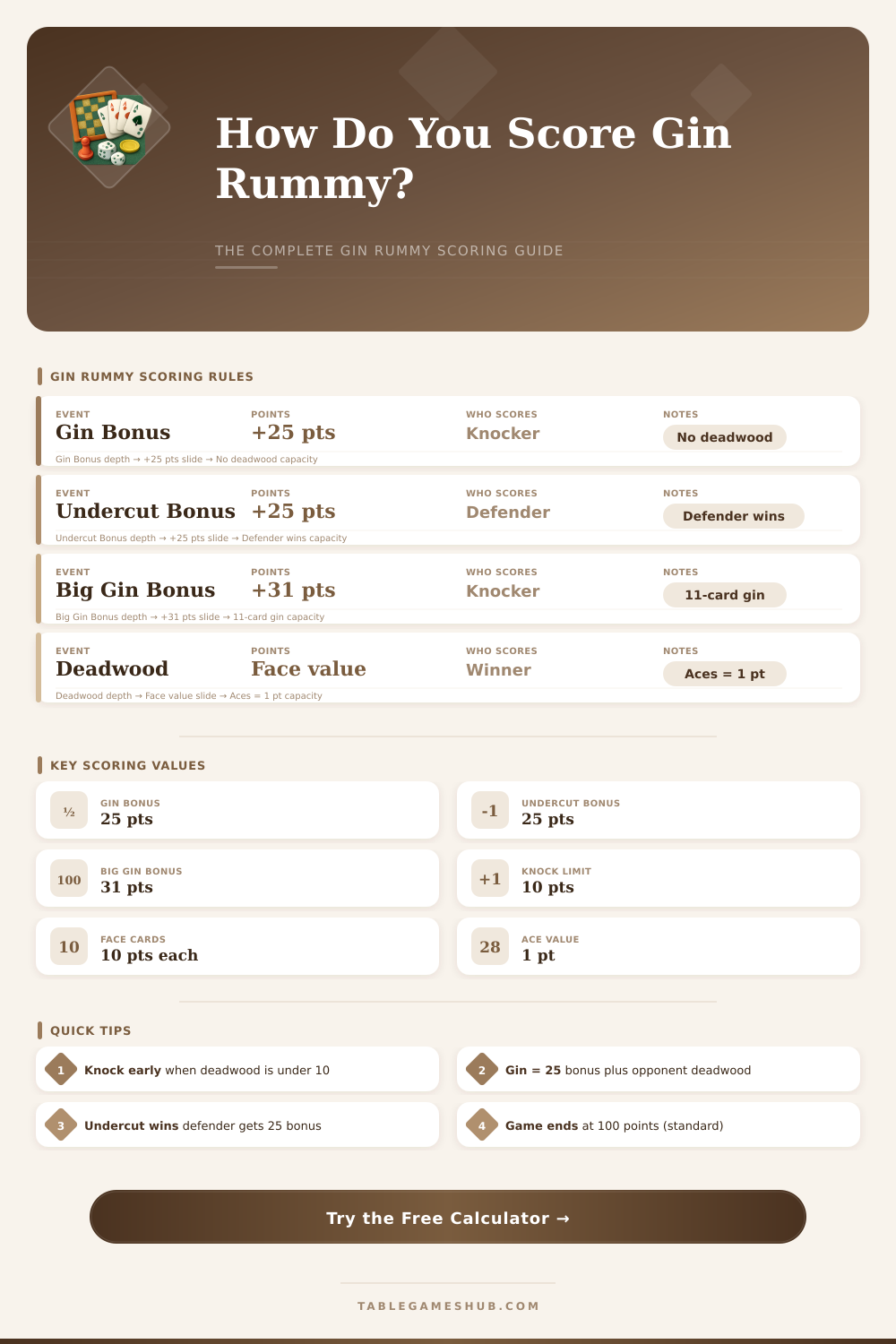
Knowing the values of the cards is the most important step to start well. Cards with faces, as kings, queens and jacks, each has 10 Points. The ones from 2 until 10 value according to their number.
How to Play Gin Rummy and Score Points
Aces are the lowest with only 1 point each. The order of the cards from the highest until the lowest is: king, queen, jack, then ten down until ace.
The cards that stay in the hand of a player and do not belong to any set one calls dead wood. The Points of that dead wood are important, because they decide who wins and by how much. When a player strikes, the difference of dead wood between both goes to the striker.
For instance, if the striker has 5 Points of dead wood and the opponent 12, then teh striker receives 7 Points.
When someone strikes, the opponent has a chance to use the sets and runs of the striker before one counts the dead wood. This can totally change the situation in a moment. If the opponent ends with a lower score of dead wood than the striker, that is called an undercut.
So the opponent then receives a bonus, usually 10 Points, together with the difference of the dead wood.
Going gin means to strike with zero dead wood. It gives a bonus plus any Points from the dead wood of the opponent. The size of the Gin Rummy bonus depends on the used rules.
Some play it for 20 Points, others for 25. There is also big gin, that is worth a hole group of 40 Points.
At the end of the whole game, every player adds 25 Points for each won hand. One calls this bonus line or box bonus. More boxes can come because of things as going gin or doing an undercut.
Those extra boxes do not affect the score during the game itself, but they turn into 20 or 25 Points each during the final count. If a player beats every single hand and the opponent none, that is a shutout.
Deciding when to strike instead of waiting for gin is one of the most fun parts of the game. Striking soon can catch the opponent with a lot of dead wood, what maybe is worth more than the Gin Rummy bonus itself. Even so there is also danger, because the opponent could undercut and totallyoverturn the result.
It matters to keep the whole score in your head, especially when one player almost wins.