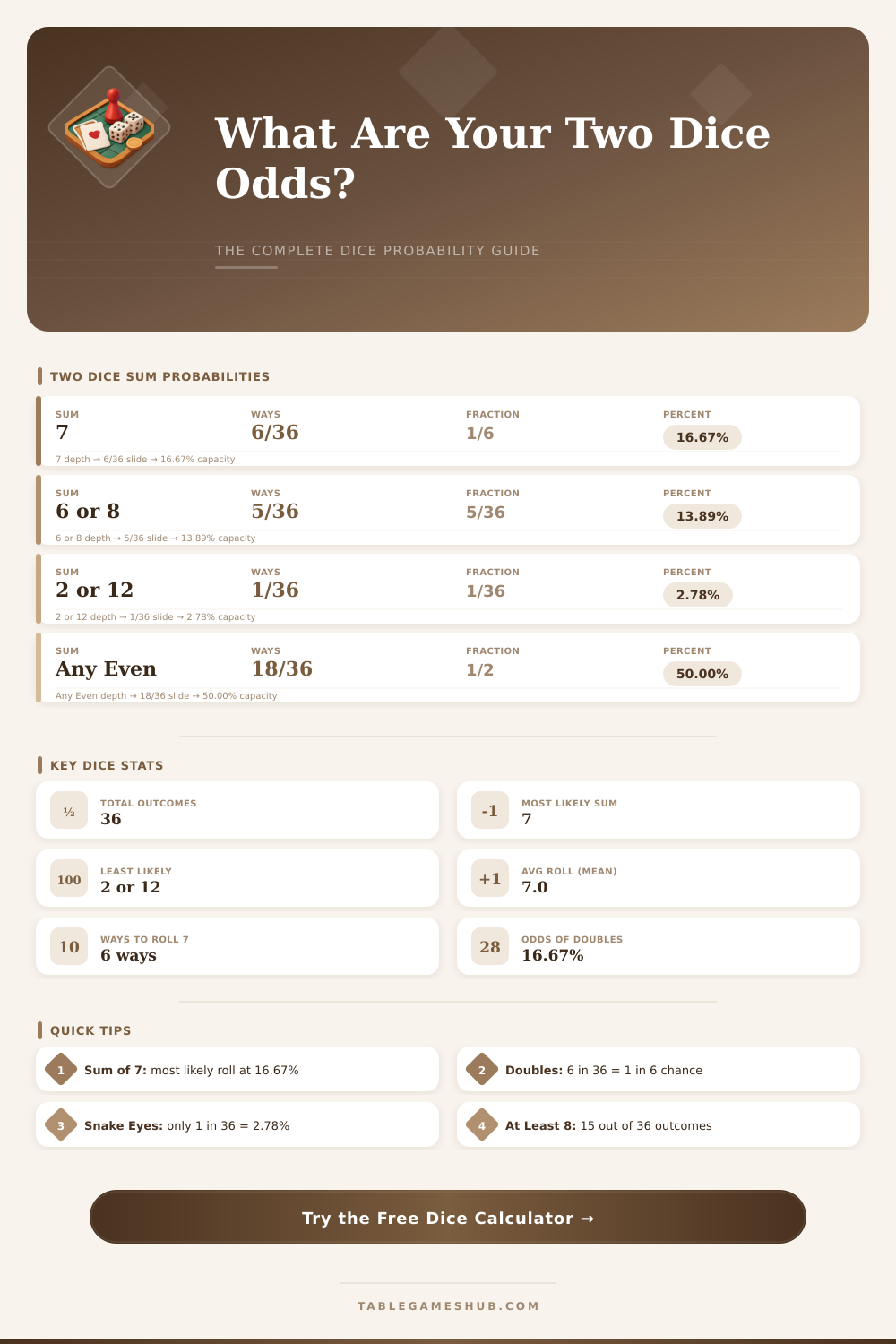
🎲 Two Dice Probability Calculator
Calculate exact probabilities, odds, and expected outcomes for any two-dice scenario
| Sum | Ways to Roll | Combinations | Fraction | Decimal | Percentage | Odds (1 in X) |
|---|
| Game | Key Roll | Probability | Ways | Strategy Note |
|---|---|---|---|---|
| Craps | 7 or 11 (Win) | 22.22% | 8/36 | Pass line wins on come-out roll |
| Craps | 2, 3, or 12 (Lose) | 11.11% | 4/36 | Craps on come-out roll |
| Monopoly | Any Double | 16.67% | 6/36 | 3 doubles in a row → Go to Jail |
| Monopoly | Roll 7 (most common) | 16.67% | 6/36 | Most visited squares ~7 from Jail |
| Catan | 7 (Robber) | 16.67% | 6/36 | Place robber, steal resource |
| Catan | 6 or 8 (Best numbers) | 27.78% | 10/36 | Highest yield non-7 numbers |
| Backgammon | Doubles (move x4) | 16.67% | 6/36 | Double moves grant extra turns |
| Yahtzee | Specific value on 1 die | 16.67% | 1/6 | Per individual die probability |
| Risk | Attacker > Defender | ~57.87% | Varies | 3v2 attacker slight advantage |
| Board Games | Roll 6 (max) | 13.89% | 5/36 | Second-most likely after 7 |
| Rolls | Prob. of Rolling 7 at Least Once | Prob. of Rolling 6 at Least Once | Prob. of Any Double at Least Once | Prob. of Snake Eyes at Least Once |
|---|---|---|---|---|
| 1 | 16.67% | 13.89% | 16.67% | 2.78% |
| 2 | 30.56% | 25.69% | 30.56% | 5.48% |
| 3 | 42.13% | 35.73% | 42.13% | 8.10% |
| 5 | 59.81% | 52.88% | 59.81% | 13.11% |
| 6 | 66.51% | 59.09% | 66.51% | 15.60% |
| 10 | 83.85% | 78.03% | 83.85% | 24.73% |
| 15 | 93.52% | 89.93% | 93.52% | 34.34% |
| 20 | 97.38% | 95.25% | 97.38% | 42.74% |
| 36 | 99.83% | 99.59% | 99.83% | 63.72% |
| Die Type | Total Outcomes (2 dice) | Sum Range | Most Likely Sum | P(Most Likely) | Expected Value |
|---|---|---|---|---|---|
| d4 (4-sided) | 16 | 2–8 | 5 | 18.75% | 5.0 |
| d6 (6-sided) | 36 | 2–12 | 7 | 16.67% | 7.0 |
| d8 (8-sided) | 64 | 2–16 | 9 | 15.63% | 9.0 |
| d10 (10-sided) | 100 | 2–20 | 11 | 10.00% | 11.0 |
| d12 (12-sided) | 144 | 2–24 | 13 | 9.03% | 13.0 |
| d20 (20-sided) | 400 | 2–40 | 21 | 5.25% | 21.0 |
Start by listing all possible combos when you roll two Dice. Every Dice has six sides, so one Dice gives six different results. The Probability of some particular number, for instance 1 or 5.
Is 1 out of 6. When you roll two Dice at the same time though, the situation changes. You multiply those chances: 6 times 6 equals 36 total combos to consider.
Which Totals Are Most Common When You Roll Two Dice
It helps to keep the two Dice separate in your mind. Maybe you imagine one red and one green, or simply call them the first and the second. Every result can be noted as a pair, like (a, b), where a shows the number on the first Dice and b on the second.
If you list all of them you would go from (1,1) to (6,6). Really, that makes a lot of pairs.
Here is where everything becomes really interesting. Not all totals have the same Probability. To reach 2?
Only one way. Same for 12 (only one combo). But for 7?
It is possible in six different ways. Those differences are huge; 7 appears six times more often than 2 or 12. The whole scale works like this: totals of 2 or 12 happen each 1 out of 36, while 3 or 11 appear each 2 out of 36.
Next, 4 or 10 happen three tiems out of 36, 5 or 9 four times. 6 or 8 reach five times out of 36. And the middle 7 appears six times out of 36.
To find the Probability of rolling a certain total, simply divide the number of ways to reach it by 36. It is basic once the different combos are considered. Really easy math.
Here is something interesting too note about two Dice: odd versus even totals. The second Dice can keep the total even or make it odd, both happen equally often. That keeps the balance between odd and even results, which stays the same always.
What if you need to roll 7 twice in a row? Well, the Probability of a total of 7 is 6 out of 36, which simplifies to 1 out of 6. Roll again, and the Probability stays the same, still 1 out of 6 for another 7.
Because those rolls do not depend one on the other, you multiply the chances: 1/6 times 1/6 equals 1/36. So, while at least one Dice is used, the Probability of 7 stays fixed at 1 out of 6.
Roll one Dice, and every number is equally likely. Cast two Dice together, and the whole picture changes. Low totals and high ones become less common, while middle numbers dominate.
Going from one 12-sided Dice to two six-sided ones totally changes the Probability, because you land near the center more often. If you want to try thosecalculations yourself, use the online tool called AnyDice, which handles the math of Dice. It is made specially for role games.