8 Sided Dice Probability Calculator – Roll Odds Fast
🎲 8-Sided Dice Probability Calculator
Calculate exact roll probabilities, sum distributions, and target outcomes for d8 dice
⚡ Quick Presets
📝 Calculator Inputs
📊 Probability Results
🎮 D8 Dice Sets & Game Components
8
Faces per Die
4.5
Mean Roll (1d8)
12.5%
Any Exact Face
5.25
Variance (1d8)
2.29
Std Deviation
64
Total 2d8 Outcomes
512
Total 3d8 Outcomes
9
Most Likely 2d8 Sum
📈 Single d8 Roll Probability Reference
| Target Roll | Exactly | At Least (≥) | At Most (≤) | Odds For |
|---|---|---|---|---|
| 1 | 12.50% | 100.00% | 12.50% | 1:7 |
| 2 | 12.50% | 87.50% | 25.00% | 1:7 |
| 3 | 12.50% | 75.00% | 37.50% | 1:7 |
| 4 | 12.50% | 62.50% | 50.00% | 1:7 |
| 5 | 12.50% | 50.00% | 62.50% | 1:7 |
| 6 | 12.50% | 37.50% | 75.00% | 1:7 |
| 7 | 12.50% | 25.00% | 87.50% | 1:7 |
| 8 | 12.50% | 12.50% | 100.00% | 1:7 |
🎲 2d8 Sum Probability Distribution
| Sum | Ways to Roll | Probability | Percentage | Cumulative (≤) |
|---|---|---|---|---|
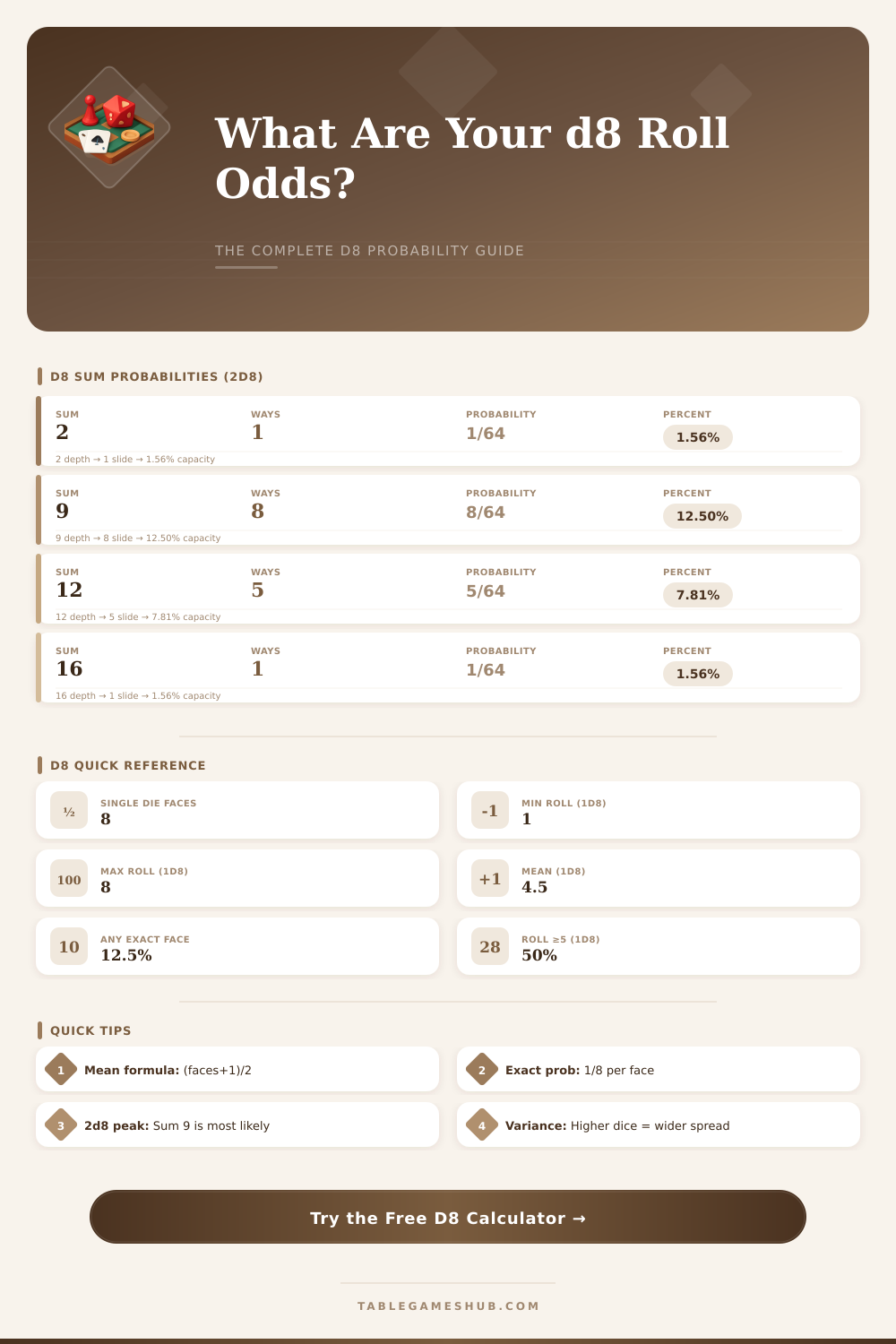
| 2 | 1 | 1/64 | 1.56% | 1.56% |
| 3 | 2 | 2/64 | 3.13% | 4.69% |
| 4 | 3 | 3/64 | 4.69% | 9.38% |
| 5 | 4 | 4/64 | 6.25% | 15.63% |
| 6 | 5 | 5/64 | 7.81% | 23.44% |
| 7 | 6 | 6/64 | 9.38% | 32.81% |
| 8 | 7 | 7/64 | 10.94% | 43.75% |
| 9 | 8 | 8/64 | 12.50% | 56.25% |
| 10 | 7 | 7/64 | 10.94% | 67.19% |
| 11 | 6 | 6/64 | 9.38% | 76.56% |
| 12 | 5 | 5/64 | 7.81% | 84.38% |
| 13 | 4 | 4/64 | 6.25% | 90.63% |
| 14 | 3 | 3/64 | 4.69% | 95.31% |
| 15 | 2 | 2/64 | 3.13% | 98.44% |
| 16 | 1 | 1/64 | 1.56% | 100.00% |
🎮 Common D8 Usage in Tabletop Games
| Game / System | Dice Used | Purpose | Avg Result | Range |
|---|---|---|---|---|
| D&D 5e – Longsword | 1d8 | Damage roll | 4.5 | 1–8 |
| D&D 5e – Rapier | 1d8 | Piercing damage | 4.5 | 1–8 |
| D&D 5e – Cleric Spell | 2d8 | Healing / damage | 9.0 | 2–16 |
| Pathfinder – Rogue | 2d8 | Sneak attack | 9.0 | 2–16 |
| Warhammer RPG | 2d8 | Wound rolls | 9.0 | 2–16 |
| Shadowrun | Xd8 | Initiative roll | 4.5X | X–8X |
| Call of Cthulhu | 1d8 | Damage (knife) | 4.5 | 1–8 |
| Star Wars RPG | 1d8 | Force dice variant | 4.5 | 1–8 |
📊 Multi-D8 Expected Values & Ranges
| Dice Count | Min Sum | Max Sum | Expected Mean | Std Deviation | Total Outcomes |
|---|---|---|---|---|---|
| 1d8 | 1 | 8 | 4.50 | 2.29 | 8 |
| 2d8 | 2 | 16 | 9.00 | 3.24 | 64 |
| 3d8 | 3 | 24 | 13.50 | 3.97 | 512 |
| 4d8 | 4 | 32 | 18.00 | 4.58 | 4,096 |
| 5d8 | 5 | 40 | 22.50 | 5.12 | 32,768 |
| 6d8 | 6 | 48 | 27.00 | 5.61 | 262,144 |
| 8d8 | 8 | 64 | 36.00 | 6.48 | 16,777,216 |
| 10d8 | 10 | 80 | 45.00 | 7.25 | 1,073,741,824 |
💡 Probability Tips & Notes
🎯 Mean & Variance Formula: For Nd8, the expected mean = N × 4.5 and variance = N × 5.25. Standard deviation = √(N × 5.25). With more dice, the distribution approaches a bell curve by the Central Limit Theorem.
🎲 Advantage Mechanic: Rolling 2d8 with advantage (take the higher) raises the effective average from 4.5 to approximately 5.81. Disadvantage (take lower) drops it to roughly 3.19. This is a significant 29% shift in expected outcome.
📐 Counting Combinations: For 2d8 sum S, the number of ways = S−1 if S ≤ 9, or 17−S if S ≥ 9. Total outcomes = 64. Probability = ways/64. The peak sum of 9 has 8 ways (12.5% chance).
🔄 At-Least Probability: P(roll ≥ target on 1d8) = (9 − target) / 8. So P(≥5) = 4/8 = 50%. For multiple rolls, P(at least one success in N rolls) = 1 − (1 − p)^N where p is single-roll success probability.
A normal Dice has six sides, and each of them can happen equally. Because there are six possible results, the Probability of some particular number is one in six. That matches around 16.67 percent for one side.
So, if you hope for 3, 1, or 6, those chances stay the same.
Probability with One and Two Dice
Add now a second Dice to the game, and the situation becomes much more interesting. Roll two normal six-sided Dice, and there suddenly appear 36 different combiantions. Here is where it becomes tricky, the total 7 happens more commonly than any other, thanks to six different ways to reach it.
On the other hand, 2 and 12 are very unlucky, each of them only once between those 36 possibilities. The numbers between them spread across the whole range: you can reach 3 or 11 by two ways, 4 or 10 by three, 5 or 9 by four, and 6 or 8 by five. Like this you understand, that one single Dice treats every number the same, but two Dice strongly favor the 7.
The sample space simply is a nice term for “every result, that could happen”. With Dice, it covers all possible rolls, that you could get. Listing those spaces is the first step, when you count any Probability problem.
Roll one single Dice and you get what is called flat distribution, each number has equal chance. But when you roll several Dice and add them, the curves change. Big values less likely become, while results near to the center more commonly appear.
Two Dice form something like a pyramid, while three or more smooth into a natural bell curve. In many games, the players do not care about the precise number always, they simply try too reach or beat their target.
You can find Dice Probability calculators everywhere on the net, and they can solve almost any case. Six-sided, four-sided, or twenty-sided Dice… No effort.
They compute the chances for a particular total, for rolling under a set value or above another. Many of those programs are meant for role games, especially the one called Dungeons and Dragons.
There is also a clever shortcut, called the complementary rule, that helps with harder tasks. Assume, you want to know the chance, that at least one of four Dice shows 5 or 6. Here is the trick: take the Probability, that none of them do, and subtract from 1.
The Probability, that one Dice falls under 5, is two in three, so for all four it is (2/3) to the fourth power. Subtract that from 1, and you get 65/81. Even and odd results have their own rules also.
If the first Dice is even, the total of two Dice has equalchance to be even or odd, same, if it is odd.