4-Sided Dice (D4) Probability Calculator – Instant Results
🎲 4-Sided Dice (D4) Probability Calculator
Calculate exact probabilities for any D4 roll, target value, or combination of dice
⚡ Quick Presets
⚙️ Calculator Inputs
📊 Probability Results
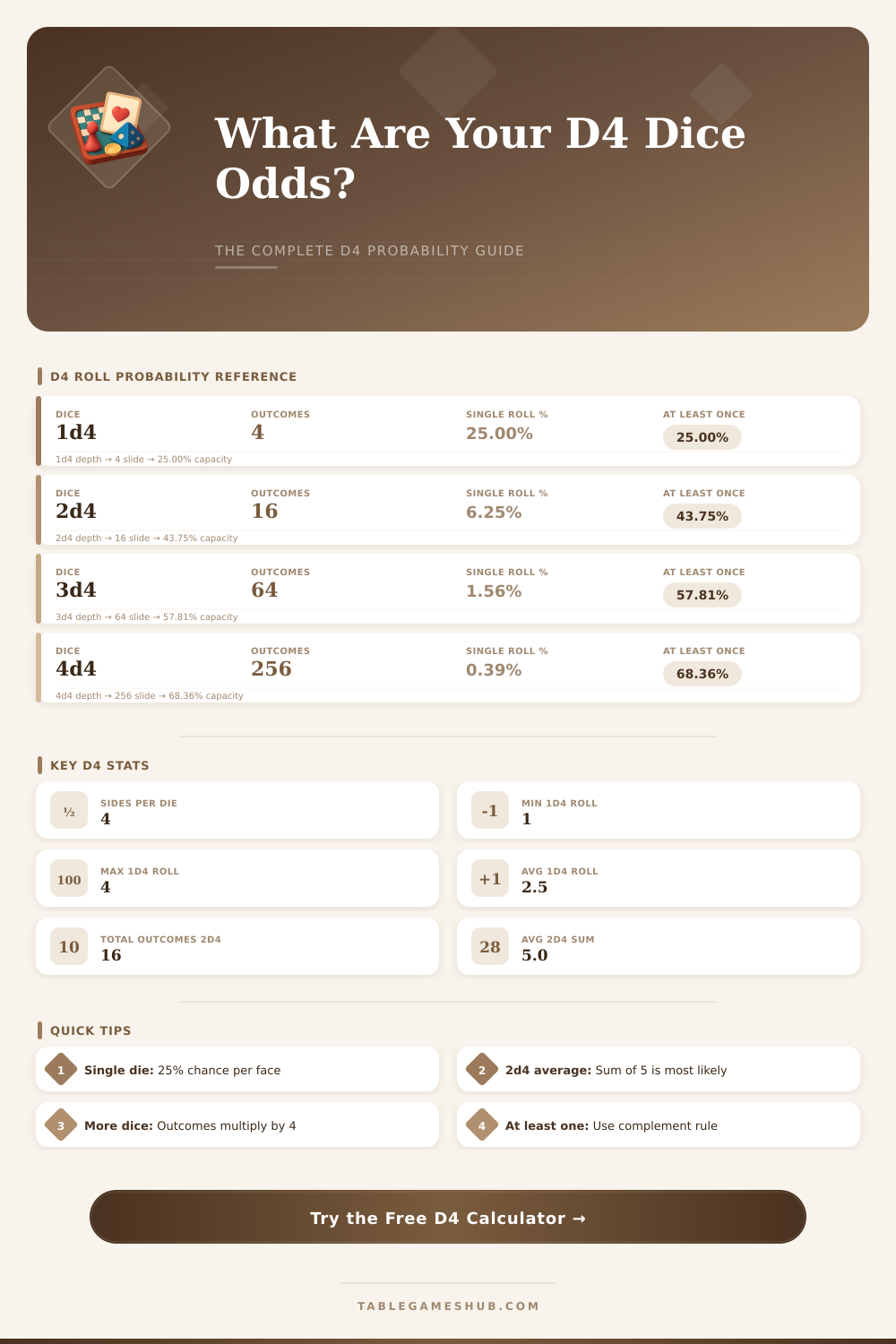
📋 D4 Quick Stats
4
Sides
2.5
Avg Roll (1d4)
25%
Any Face Odds
5.0
Avg Sum (2d4)
7.5
Avg Sum (3d4)
10.0
Avg Sum (4d4)
0.39%
All 4s on 4d4
256
Outcomes (4d4)
🎯 D4 Probability Distribution Table
| Roll Value | 1d4 Probability | 1d4 Cumulative (≥) | 2d4 Sum Probability | 3d4 Sum Probability |
|---|---|---|---|---|
| 1 | 25.00% | 100.00% | — | — |
| 2 | 25.00% | 75.00% | 6.25% | — |
| 3 | 25.00% | 50.00% | 12.50% | 1.56% |
| 4 | 25.00% | 25.00% | 18.75% | 4.69% |
| 5 | — | — | 25.00% | 9.38% |
| 6 | — | — | 18.75% | 15.63% |
| 7 | — | — | 12.50% | 18.75% |
| 8 | — | — | 6.25% | 15.63% |
| 9 | — | — | — | 9.38% |
| 10 | — | — | — | 4.69% |
| 11 | — | — | — | 1.56% |
| 12 | — | — | — | — |
🎲 Multi-Dice Total Outcomes & Averages
| No. of D4 | Total Outcomes | Min Sum | Max Sum | Average Sum | Std Deviation |
|---|---|---|---|---|---|
| 1d4 | 4 | 1 | 4 | 2.50 | 1.12 |
| 2d4 | 16 | 2 | 8 | 5.00 | 1.58 |
| 3d4 | 64 | 3 | 12 | 7.50 | 1.94 |
| 4d4 | 256 | 4 | 16 | 10.00 | 2.24 |
| 5d4 | 1,024 | 5 | 20 | 12.50 | 2.50 |
| 6d4 | 4,096 | 6 | 24 | 15.00 | 2.74 |
📐 Advantage / Disadvantage Probabilities (1d4)
| Result Value | Normal | Advantage (Higher) | Disadvantage (Lower) |
|---|---|---|---|
| 1 | 25.00% | 6.25% | 43.75% |
| 2 | 25.00% | 18.75% | 31.25% |
| 3 | 25.00% | 31.25% | 18.75% |
| 4 | 25.00% | 43.75% | 6.25% |
💡 Tips & Notes
📌 Complement Rule: The probability of rolling AT LEAST X equals 1 minus the probability of rolling less than X. For example, P(roll ≥ 3 on 1d4) = 1 – P(roll ≤ 2) = 1 – 0.50 = 50%.
📌 Multiple Independent Dice: When rolling multiple d4 and looking for a specific outcome across all of them, multiply individual probabilities. For at-least-one results across N rolls, use: P = 1 – (1 – p)^N where p is the single-roll probability.
📌 Advantage vs. Normal: Rolling with Advantage (roll 2d4, take highest) increases the expected value from 2.5 to 3.125. Disadvantage (take lowest) drops it to 1.875 — a significant impact in games like D&D.
📌 Sum Distribution: The sum of multiple d4 follows a bell-curve-like distribution. For 2d4, sums of 4 and 5 are most likely (25% and 25% combined). For 3d4, sums of 7 and 8 are the mode values. More dice = more center-weighted results.
Dice Probability is about the four-sided die, one of those shapes that people use in board games. Every side has equal chance to land upward. Because always one side appears up, the whole probability adds to 1 so each side has a 1/4 chance.
That makes sense, because we have four equally likely results.
Four-Sided Dice: Chance and Averages
Rolling one alone four-sided die, the average is figured easily. Add all numbers on it: 1+2+3+4 makes 10. Then divide that total by the number of sides, which is 4.
So the expected result of one four-sided die is 2.5.
When we roll two four-sided dice, things become more interesting. A fair four-sided die, rolled twice, gives sixeten possible combinations, and each of them is equally likely. One can list all pairs: (1,1), (1,2), (1,3), (1,4), (2,1), (2,2) and so on until (4,4).
From that list we can answer various questions about Dice Probability.
For instance, what is the chance that two four-sided dice add up to a particular number? To reach a sum of 4 there are three ways: 1+3, 2+2 and 3+1. So the probability is 3 out of 16, or 0.1875.
One also can consider the highest side seen. Rolling two dice and looking at the maximum, the highest value 1 happens only once out of sixteen. The maximum 4 appears seven times, because each pair with 4 counts.
What happens rolling four four-sided dice? The chance too have four of the same kind, so all four land on the same side, is 1/64. Take a clear case: the chance to roll 4 on one die is 25 percent.
But to roll 4 four separate times on four dice, that is (1/4) to the fourth power, which comes to around 0.4 percent. That shows a huge drop.
Online calculators for Dice Probability can solve such tasks. Some of them support four-sided, six-sided, eight-sided, ten-sided, twelve-sided and twenty-sided dice. It helps to figure out chances for any games of luck or for teaching basic ideas of statistics, like the sample space.
Another advanced tool, called AnyDice, is designed for role games. To use it, simply enter the number of dice and the sides, and the program takes care ofthe rest.
There is also a simple but useful method. With three four-sided dice there are 4×4×4 possible results. Write a bit of code or use a spreadsheet to go through each of them and count how many match your target.
It is not fancy, but it works well to check your math.